If you're considering a luxury hot tub, one of the first decisions you'll face is whether to go wood-fired or electric. Both have their place — but they offer genuinely different experiences, running costs, and lifestyles. Here's an honest comparison to help you decide.
What's the difference?
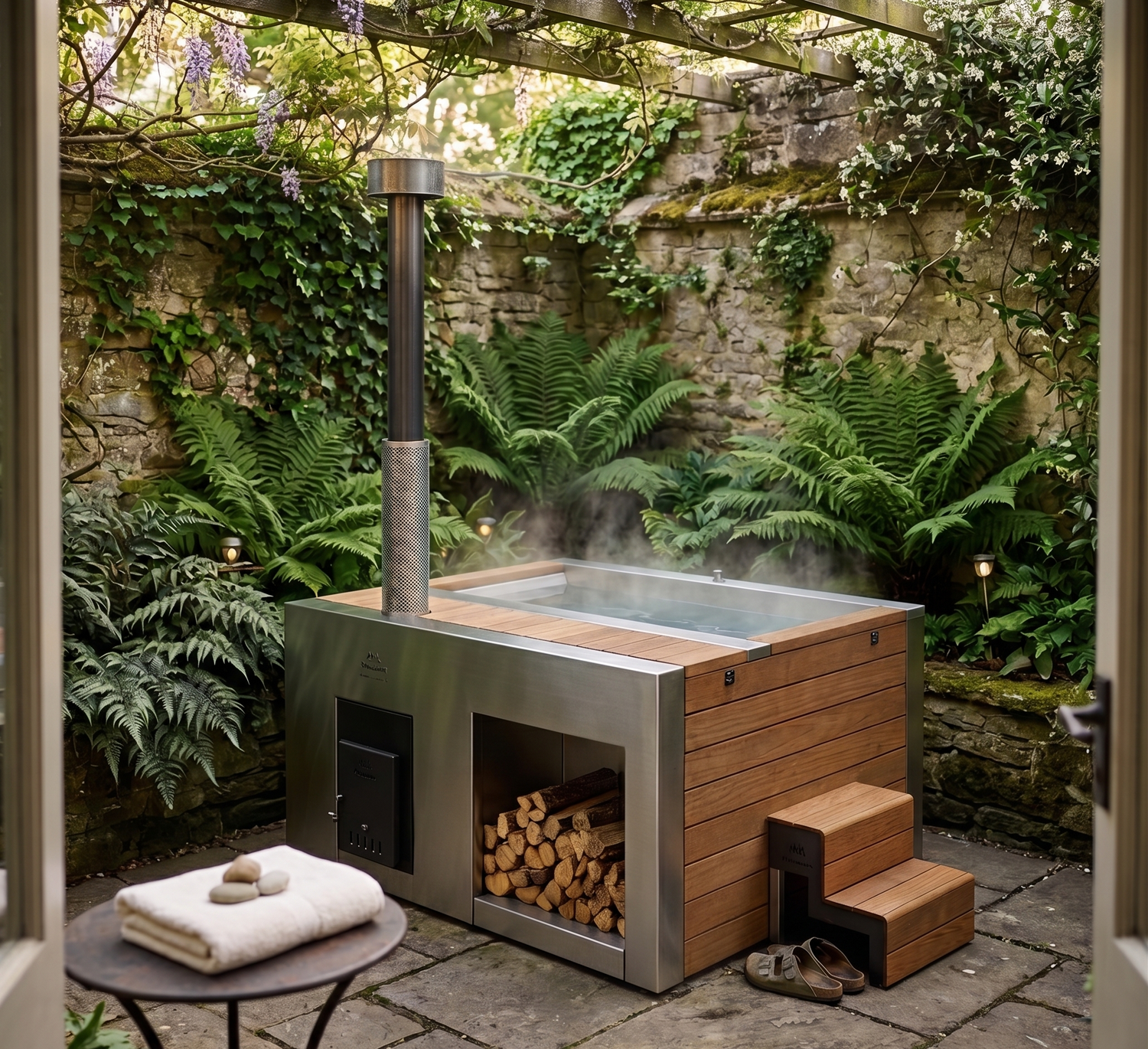
A wood-fired hot tub heats the water using a log burner — typically a high-output wood-fired water heater built into the tub itself. There's no electricity involved in the heating process. You fill the tub, light the fire, feed it with logs, and the water reaches soaking temperature in roughly two to two and a half hours.
An electric hot tub uses an integrated heating element powered by a mains supply, controlled via a panel or app. You set the temperature and the tub maintains it, ready to use whenever you want.
The benefits of wood-fired hot tubs
No electricity costs
This is the headline advantage. A wood-fired tub costs nothing to run beyond the price of firewood. With electric hot tubs costing anywhere from £50 to £150 per month in electricity depending on usage and energy tariffs, the savings over a decade of ownership are substantial.
Off-grid capability
Because wood-fired tubs need no power supply, they can be installed anywhere — a remote field, a hilltop terrace, a woodland retreat. No need to run cables or install an outdoor power supply, which can itself cost thousands.
The ritual and the experience
There's something genuinely different about a wood-fired soak. Lighting the fire, watching the steam rise, feeding the logs while the water warms — it becomes part of the experience rather than a chore. Many owners describe it as one of the most satisfying parts of their evening.
Lower environmental impact
Sustainably sourced firewood is a carbon-neutral fuel. If you're conscious of your household's environmental footprint, wood-fired heating is the cleaner choice.
Simpler engineering, longer life
Without pumps, heaters, control boards, or jets to maintain, a wood-fired tub has far fewer components that can fail. Properly built, one should last decades with minimal intervention.
No chemicals — or far fewer
Wood-fired tubs are typically drained and refilled rather than chemically maintained. This means no chlorine or bromine, no water testing kits, and no ongoing chemical costs — just clean, fresh water every time.
The benefits of electric hot tubs
Always-on convenience
An electric tub can be set to maintain temperature around the clock, so it's ready to use at any moment — no two-hour wait. For families or frequent spontaneous use, this is a real practical advantage.
Precise temperature control
You dial in exactly the temperature you want and it stays there. No stirring required, no guesswork.
Year-round use in any weather
Because electric tubs hold heat continuously, they're particularly well suited to cold climates where you want to dip in and out at short notice.
Hydrotherapy jets
Most electric hot tubs include massage jets, which wood-fired tubs don't. If hydrotherapy is a priority for you, electric is the natural choice.
Are wood-fired hot tubs worth it?
For the right buyer, absolutely. The question is whether you value the ritual, the off-grid independence, and the lower running costs over the instant convenience of electric.
If you want to flick a switch on a Tuesday evening after work and be in the water in ten minutes, electric makes more sense. If you want a deeply satisfying, deliberate weekend ritual — and you'd rather spend that time outdoors than paying energy bills — wood-fired is hard to beat.
At Tubmarine, we build both. Our wood-fired tubs are handmade in Dorset from 316 marine-grade stainless steel and sustainably sourced Kebony timber, with a 29kW Kirami wood-fired heater that brings the water to temperature in around two hours. They need no electricity, no chemicals, and are built to last a generation.
Our electric tubs use the same materials and the same standard of craftsmanship — with the addition of a high-efficiency heating system for those who want the convenience of always-on hot water.
Both carry a 10-year structural guarantee as standard.
Still deciding?
If you're not sure which is right for your situation — your garden, your lifestyle, your access — we're happy to talk it through. Get in touch and we'll give you an honest answer, not a sales pitch.
Explore wood-fired hot tubs → Explore electric hot tubs → Get in touch →